
The world is full of conflicting political ideologies. While there are some larger blocks that you may be aware of, Royalists, Representativists and Aequalists, in this article I’d like to take the opportunity to provide a further degree of nuance to this political spectrum.
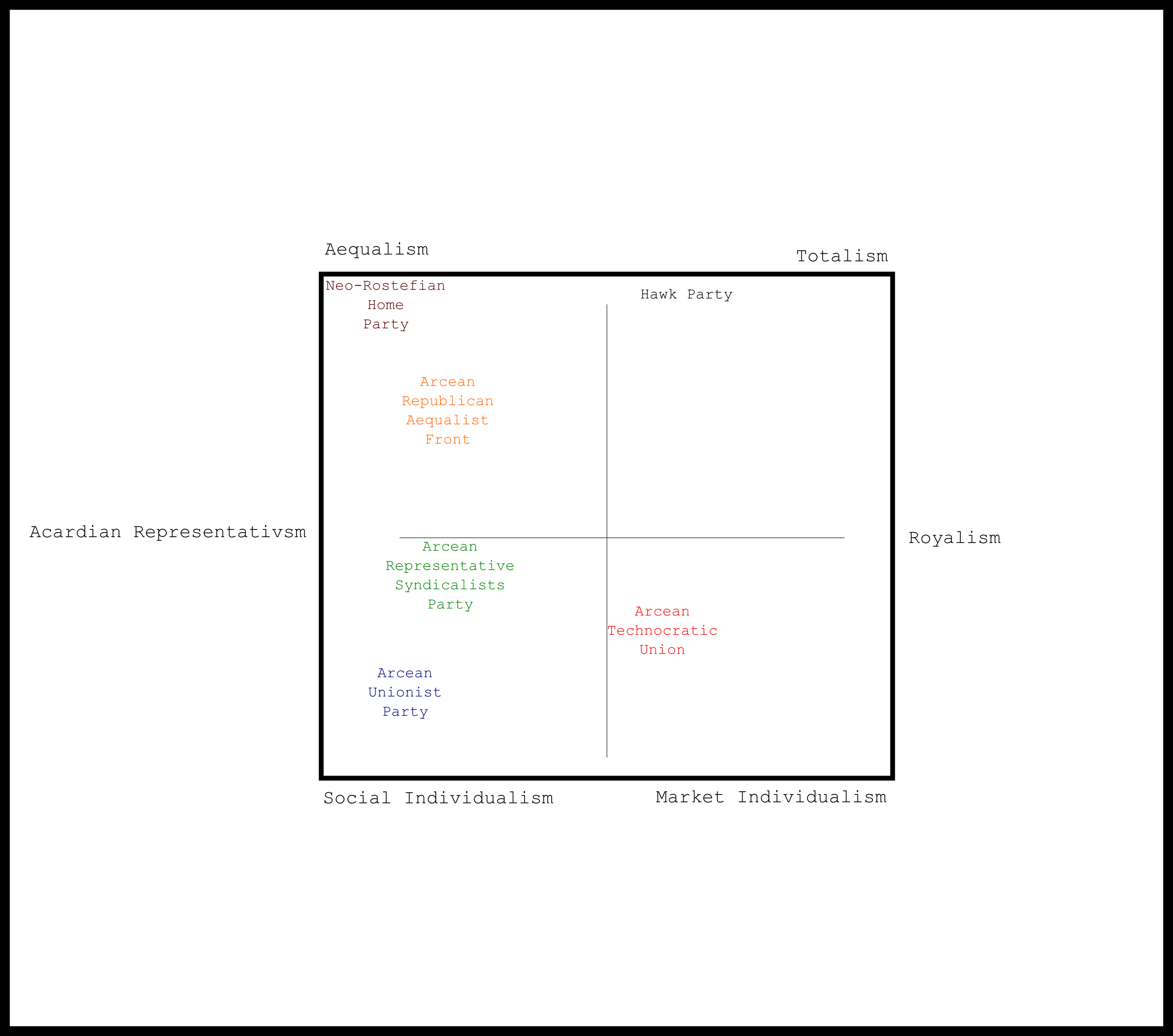
At the far end of the left are Aequalists. Given the ideology has struggled to gain serious traction outside of Aztlan over the last century, Hidalco has been able to largely shape the modern ideology in his own image. Aequalism, traditionally holds that there is enough resources to ensure that everyone can live comfortable, and, with an effective centrally administered, meritocratic bureaucracy, these resources can be distributed evenly. In its brief implementations in Rostef and the former UHR, the issue of creating an effective centrally administered meritocratic bureaucracy proved to be too much for these states. In both cases, these states were not created or ran by the sort of experienced bureaucrats that would be needed to create and manage such as system, Hidalco on the other hand is. As such, he has been successful, and Aztlan has become proof to many Aequalists that their utopian dreams hold weight. Others generally view Hidalco’s crushing of opposition as proof of failure and hold that the recent economic slowdown in Aztlan points to nepotism in the system and, because of this, inevitable decay and death. Because of this, continental Aequalism has evolved into an almost completely different ideology.
As one would imagine, Representativism creates a great deal of room for competing trains of thought. At its most extreme end are Representative-Aequalists. Representative-Aequalists, or Rep-A’s as they are often referred to as, are different from most Representativists in that they generally believe that economic freedom runs contrary to political freedom. They believe that any amount of private control over the economy generally reduces the people’s capacity to operate freely in civil society. As such, the economy must be controlled by a central democratic institution, thus protecting civil freedom from private interest. Rep-A’s view themselves as the true successors of Acard, the first Arcean president who at some points called her ideology Representative Aequalism. This ideology is general popular in Rostef as well as much of North Ghurrka, but has struggled to gain traction outside of these regions.
Often compared to the Rep-A’s are the Representative Syndicalists. Rep-Syn’s believe that a private economy is an essential part of civil freedom and that the two cannot be untied from each other. They agree with Rep-A’s that a democratic economy is essential in preserving a democratic society. As such, they are skeptical of corporations and instead promote syndicates, institutions similar to corporations but instead run by popular vote, not a board of directors or a CEO. This ideology is the most popular ideology in Arcea and has come to greatly change the lens through which all other ideologies in Arcea operate. It is also very popular throughout much of the Union and beyond. Rep-Syn’s are often viewed as the center-left in most Union countries.
The main opponent to Rep-Syn’s in most Representativist countries are the Technocrats. Techno’s generally disagree with Rep-A’s and Rep-Syn’s on corporations, believing that the effects of non-democratic workplace can be negated through a highly-educated electorate and unions. They also believe that companies should be allowed to live and die in a free market, while most Rep-Syn’s and Rep-A’s are willing to support ailing industries. Representative Technocratism is popular in Sudfell, but has truly made itself at home in Enshaw and Seabring. Techno’s are generally viewed as the center-right in most union countries.
Royalism also has a great deal of ideological disparity. Generally, the most left wing Royalists, such as Frida of Karelia Khogun Hathor of Shirudo, believe that quick adoption of new technologies and organizational ideas are essential to the preservation of the crown and for being competitive against Representativist economies. Given that being ready for change requires an educated workforce, and that educated workforces go hand in hand with a civically engaged population, Technocratic Royalists are often willing to give their population official channels to openly air grievances. Whether that be through a free press, some sort of legislature or a combination of both. This in turn generally means that the monarch and their bureaucracy must capable of addressing the more serious grievances.
Royal Totalism is more common however. Mengsk of the South Arcean Empire is perhaps the most well-known example Royal Totalists. This ideology borrows a great deal from famous Totalists such as Spyker and Foreman, the focus being on supporting an oligarchy built on a cult of personality dedicated towards a single individual. The press and any legislature, should it exist, are only tools to further enrich and empower the ruling class. Beyond that, Royal Totalism generally requires a military that is at least capable of seeming intimidating to its own people, to both inspire fear and awe at the might of the state in its people. Ironically, Royal Totalist states, at least economically, usual struggle with comparable open societies.
At the most extreme end of the spectrum is where you find Totalists. Totalists believe other ideologies are generally too slow and mired in bureaucracy to effectively address the needs of the people. They also believe that striving for peace is a show of weakness. Perhaps most worryingly, they view history as a struggle between races, religions and ethnicities. As such, they believe it is human nature to dominate over others and that the only way they can ensure their peoples preservation is through the conquest and domination. Fortunately, with the fall of Foreman and the death of Spyker and Magna Tranfa at the end of the Great War, this ideology has slowly been dying off with the remnant of Foreman’s supporters in Shirudan Hesse.

